Your notebook shouldn't just hold your notes. It should work with you.
Open it at any page. You can see straight away that it isn't a notebook like the others.

You have already had that notebook full of good intentions
The one you opened in September, full of hope. The first pages are neat, almost beautiful. Then the weeks go by, the lessons pile up, and it goes back to what it always was: a place where you drop words, not a tool that helps you keep them.
A Cornell Premium notebook does not just take your notes. It tells you where you are, what has stuck, what needs another pass, and in what order. It steers your revision for you, so you never have to guess again.
3 zones. 5 steps. One page that does all the work.
The Cornell method has been around for 70 years, developed by Walter Pauk at Cornell University. It splits each page into three zones: a column of key words, a large notes area, a summary at the bottom. Three zones, three moments: during the lesson, right after, and at revision time.
The Cornell Premium notebook does not stop at drawing those three zones. It builds in the 5 steps R1 to R5, the tracking boxes and the memory thermometers, so the system no longer depends on your discipline alone, but on the structure of the page itself.
What Cornell Premium does differently from a classic Cornell notebook
The 5 Rs built into the structure
The R1 box shows whether the notes were taken. The R2 to R5 thermometers follow each revision cycle, subject by subject. You no longer have to remember where you are: the notebook tells you.
The active contents page
Subject, pages, R1, R2 to R5 thermometers: your own index builds itself as you go. A student who finds their notes in 30 seconds revises more than a student who searches for 10 minutes.
The memory thermometers
Four visual thermometers, one per step R2 to R5, filled in at each revision cycle. At a glance, you know which subject is solid and which one needs another pass.
The R1 attendance check
A student who was absent cannot revise a lesson they never had. The R1 box flags missing notes to catch up on straight away, with no separate system.
The control page
A double opening page dedicated to the active contents and the overall thermometers. You get a wide view of the whole notebook the moment you open it, not a page 1 with no landmarks.
Structured end pages
Personal glossary and further resources: the vocabulary specific to a subject and your key references, in the same notebook as your notes. The friction between the lesson and the revision disappears.
The choice of inside ruling
Lines, dots, or 5x5 small squares. Dots and squares for diagrams, maths, mind maps. Lines for literature, philosophy, languages. The same method, adapted to your subject.
Small format for one subject, large format for four
The small format follows a single subject in depth. The large format holds four subjects in one notebook, with a clear separation and memory boxes V1 to V4 in column 2.
The ecosystem through a QR code
A classic notebook is a closed product. Yours is a way in: method summaries, further resources, recommended tools, community. What you find behind the QR code today grows over time. The notebook stays the same. It is the access that gets richer.
Choose the format that suits the way you work
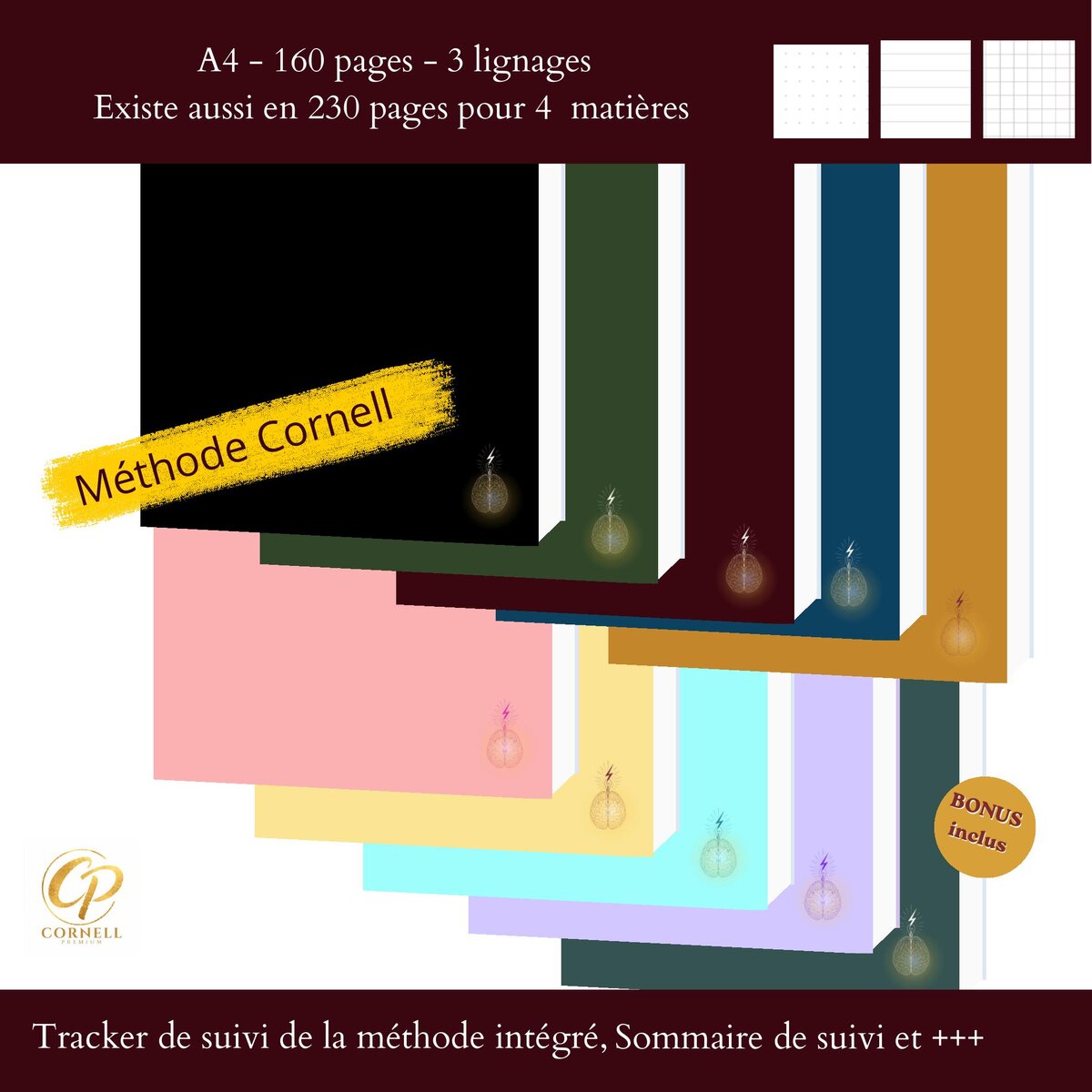
One subject format
- 160 pages
- Lines, small squares or dots
- Comes in several colours
- Ideal for following one subject in depth
Four subject format
- 232 pages
- Lines, small squares or dots
- Choice of colours
- Clear separation between the four subjects
- Two notebooks cover eight subjects over a term
Two students, two weeks before the exam
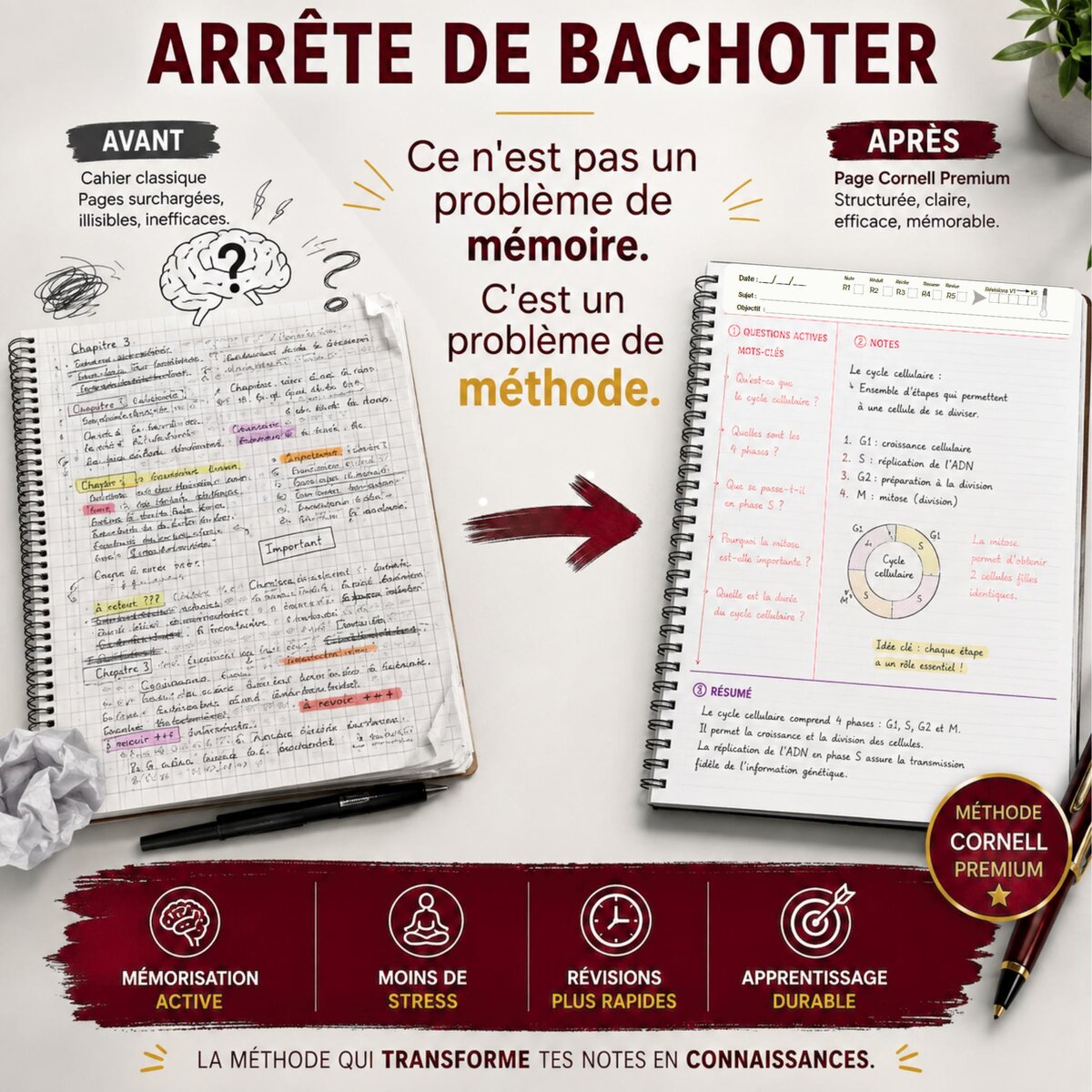
You open your notebooks one by one. You turn the pages looking for what you have already revised. Nothing tells you. You re-read everything, just in case, hoping it is enough.
You open your control page. In 30 seconds you see which subjects are green and which are still red. You know exactly where to start, and you have not lost ten minutes searching.
Your notebook is only a way in
Find the whole Cornell Premium ecosystem: the book Zéro Bachotage, your personalised guide Réussis Comme Toi, and the resources that get added over time on cornellpremium.com.
Your way of learning deserves a notebook that supports it
Not more work. Just a system that tells you where you are.
Formats, rulings and colours are all on the Cornell Premium Amazon store.
See it on AmazonWhat you are probably wondering
What is the difference from a classic Cornell notebook bought elsewhere?
Which ruling should I choose?
Small format or large format?
Do I need to have read Zéro Bachotage to use this notebook?
Your notebook shouldn't just hold your notes. It should work with you.
See it on Amazon